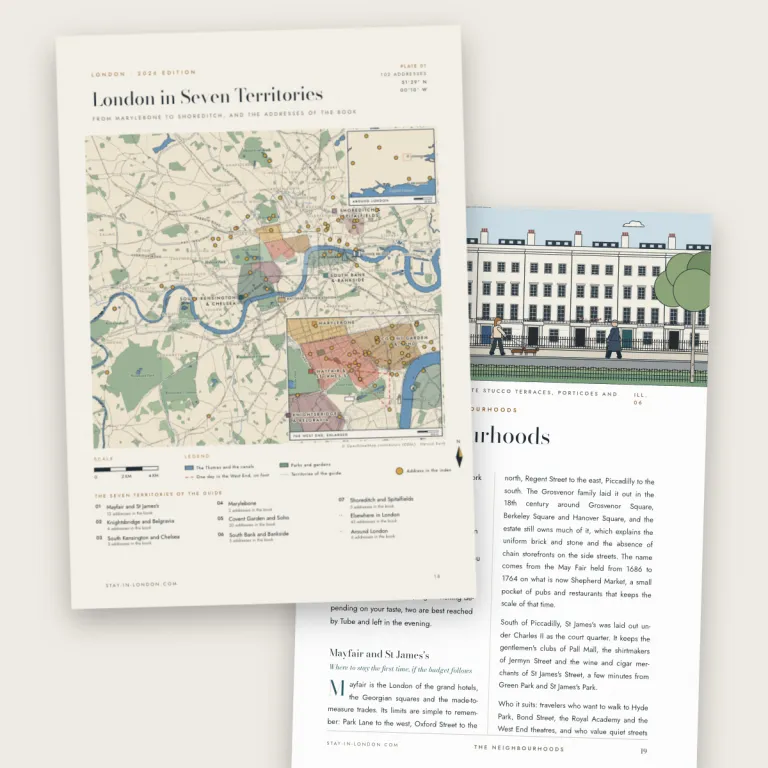
London is too large to be read as one city. Most first trips go wrong on that point: a hotel chosen for its name rather than its street, and every evening begins with forty minutes on the Tube. The London City Guide, our 2026 edition, starts from the map. It reads the city territory by territory, from Marylebone to Shoreditch, and for each one it answers the question that matters: sleep there, or just visit?

What is inside
119 plates. 102 numbered addresses, from a Georgian house in Spitalfields lit only by candles to the martini trolley of the Connaught Bar in Mayfair. 21 maps. 30 illustrations. Three itineraries. Five parts: the opening, the territory, the address book, the themes and the practical section.
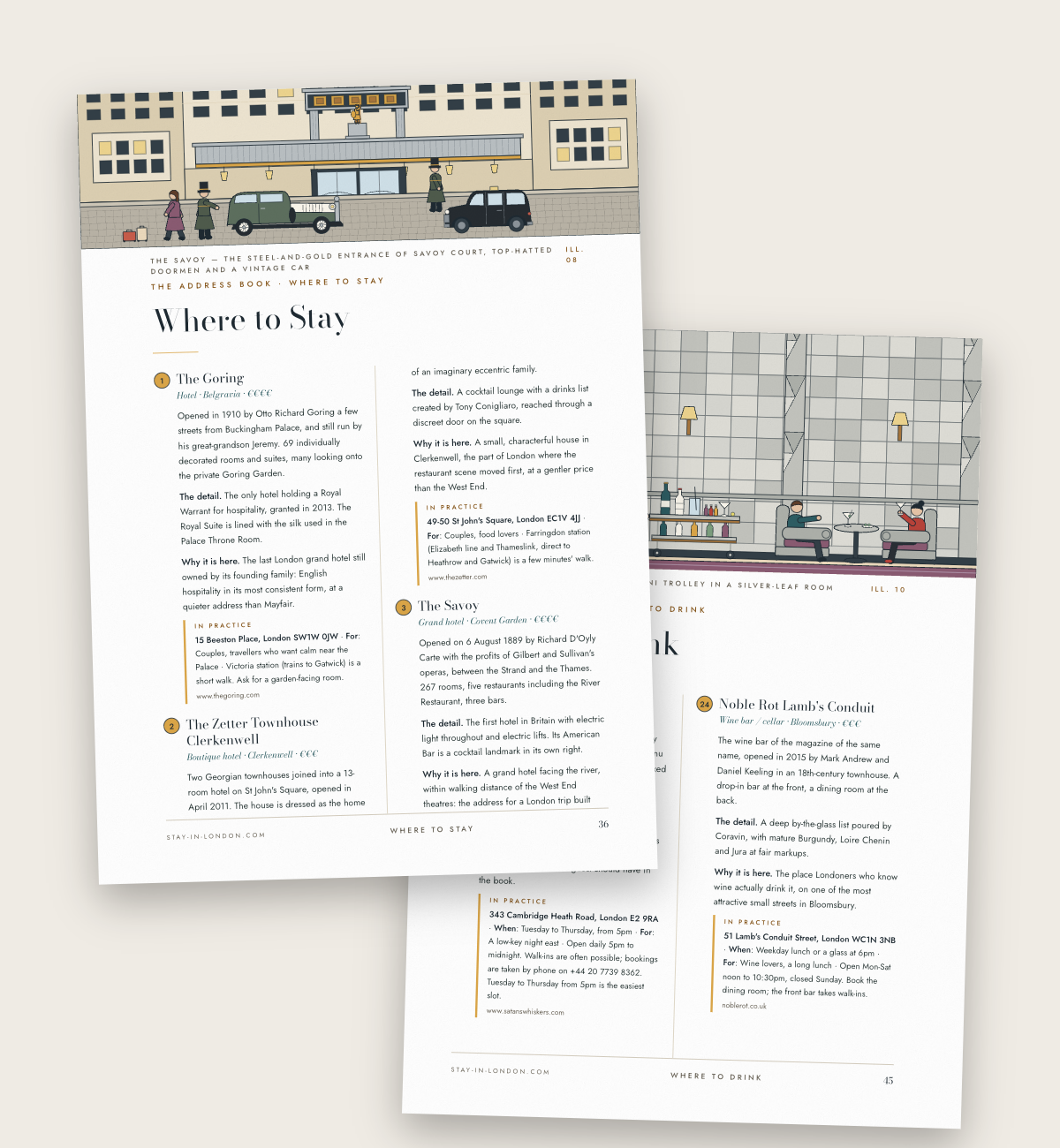
The address book is the core of it: 10 places to stay, 12 to eat, 8 to drink, 6 for coffee and early hours, 10 for shopping, 10 for culture and heritage, 8 outdoors, 5 for wellness, 6 after dark, 8 experiences, 8 dates in the calendar, 6 day trips and 5 quiet addresses for readers who already know the city.
Seven territories, from Marylebone to Shoreditch
The guide divides central London into seven territories: Mayfair and St James's, its default choice for a first visit; Knightsbridge and Belgravia; South Kensington and Chelsea; Marylebone, the alternative it recommends for a second visit; Covent Garden and Soho, the theatres and the late hours; South Bank and Bankside, one long walk by the river; and Shoreditch and Spitalfields, East London at its fullest on a Sunday.
The addresses are spread the way they really are. Covent Garden and Soho hold 20 of them, Mayfair and St James's 12, South Kensington and Chelsea, South Bank and Bankside and Shoreditch and Spitalfields 5 each, Knightsbridge and Belgravia 4, Marylebone 2. Another 43 sit elsewhere in London, from Clerkenwell to Hampstead Heath and Kew, and 6 lie around it, from Windsor to the Cotswolds and the South Downs.
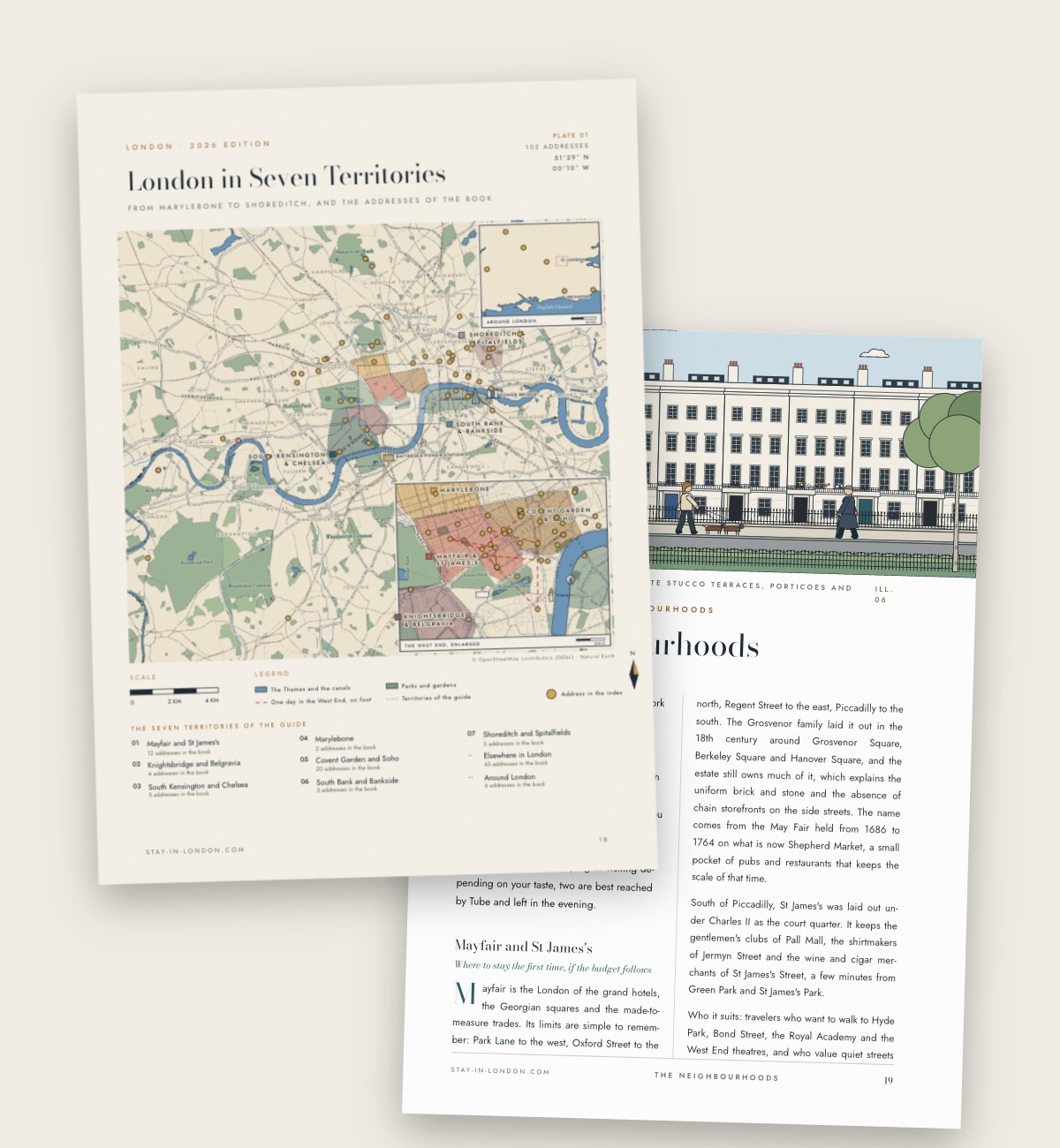
21 maps on a single base
Every map in the guide uses the same drawing of the city: same extent, same scale, same Thames, parks and streets, same place names, with the same enlarged inset of the West End and the same inset of south-east England for the day trips. Only the addresses lit in gold change, numbered as in the index. One map shows all 102 addresses, seven show one territory each, and thirteen show one chapter of the address book.
Every address says why it is there
Each entry carries its number, its category, its territory, a detail that sets it apart and one line on why it made the book, followed by a practical block: where, when, for whom.
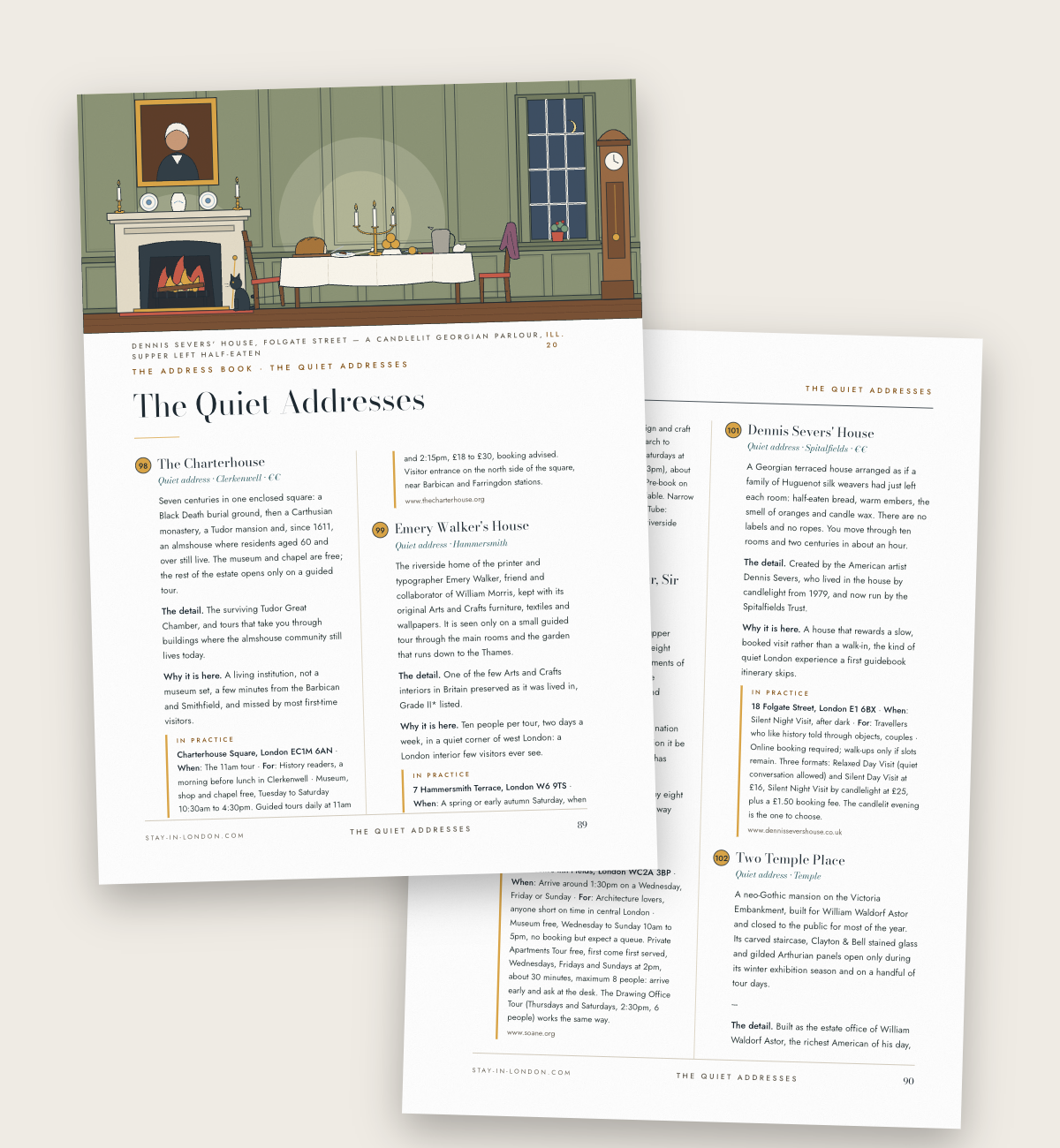
The Charterhouse, in the quiet addresses, is there because it is still lived in. Seven centuries in one enclosed square in Clerkenwell: a Black Death burial ground, then a Carthusian monastery, a Tudor mansion and, since 1611, an almshouse whose residents are still there today. The museum and chapel are free; the rest opens only on the guided tours at 11am and 2:15pm, and the guide recommends the morning one, before lunch in Clerkenwell.
Dennis Severs' House is there for a different reason. At 18 Folgate Street, a Georgian terraced house is arranged as if a family of Huguenot silk weavers had just left each room, with no labels and no ropes. The guide explains the three visit formats and says which one to choose: the Silent Night Visit by candlelight, at £25, booked online.
Three itineraries, from one day to five
Three routes built only from addresses in the guide and laid out around real opening days, because in London the calendar decides more than the map: Sir John Soane's Museum closes on Mondays and Tuesdays, Borough Market on Mondays, Windsor Castle on Tuesdays and Wednesdays.
One day in Westminster, St James's and Mayfair, on a weekday, from Raffles London at The OWO. Breakfast at The Wolseley, Westminster Abbey at the 9:30 entry, the Connaught Bar at opening, dinner at Gymkhana and the Late Late Show at Ronnie Scott's.
A weekend from Holborn to the East End and Marylebone, Friday to Sunday, from Rosewood London: the British Museum on a free timed slot, Tate Modern open late on Friday, Borough Market and Maltby Street on Saturday, dinner at Brat, and the Wallace Collection on Sunday morning.
Five days from Marylebone to Windsor, Monday to Friday, from the Mandarin Oriental Hyde Park. The City and the Ceremony of the Keys at the Tower on Tuesday, the Strand and Covent Garden on Wednesday, Hammersmith and Kew on Thursday, and Windsor on Friday, since the castle is closed on Tuesdays and Wednesdays.
Written for the way London really works
The guide is plain about money and time. It explains that prices displayed in London already include 20 percent VAT, that most restaurants add a discretionary service charge of 12.5 percent, and that a contactless card on the Tube stops charging at £8.90 a day within zones 1 and 2. It notes that January is the cheapest month for hotels, about 20 percent below the annual average, and June the most expensive.
When to read it
Before you book rather than after. In London the territory you sleep in decides the trip more than the hotel does, and the guide says, territory by territory, who each one suits. Its page gives access to the download. It opens in the browser, and it is free.